Equilibrium
MORE INFO +
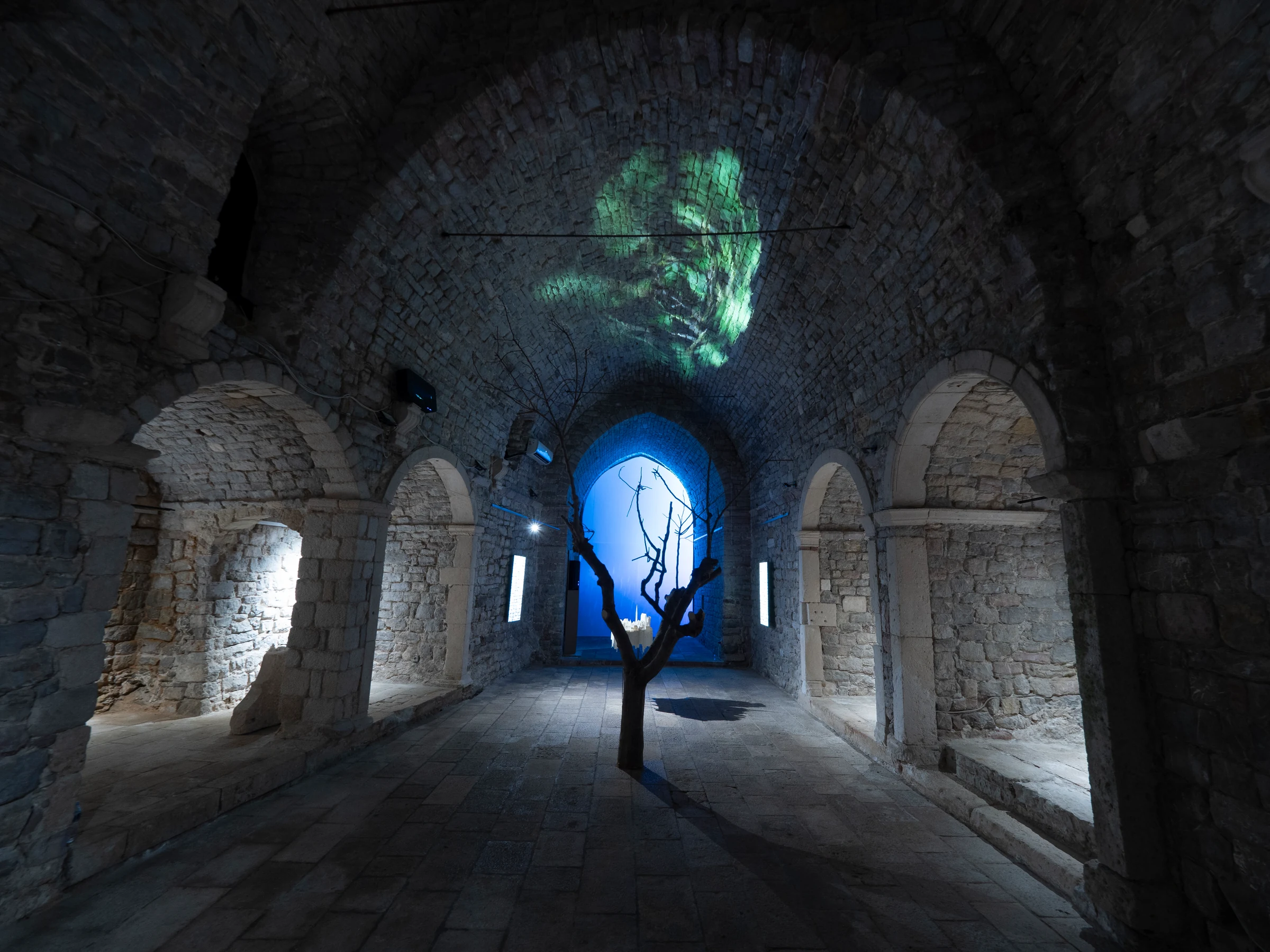
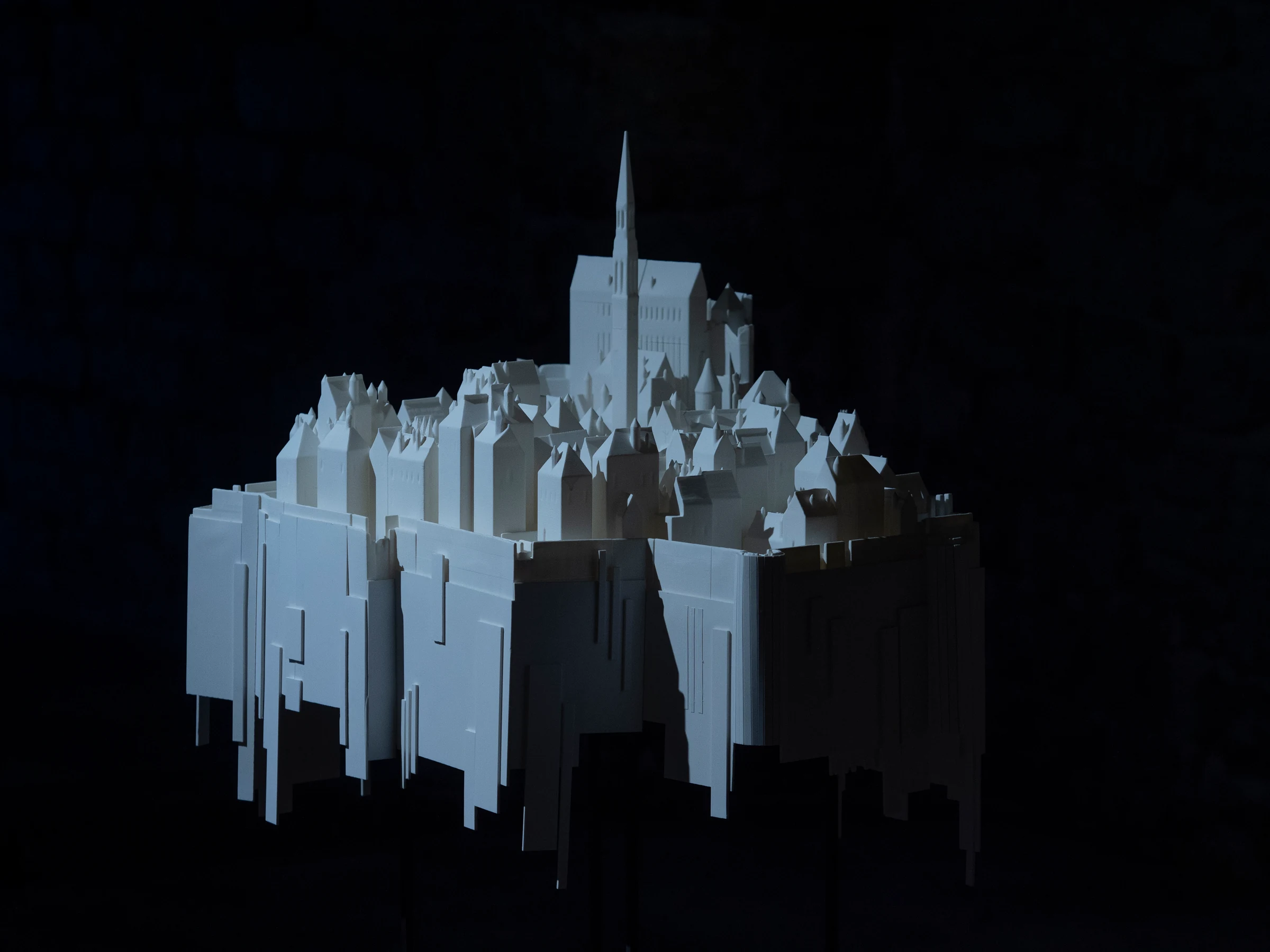
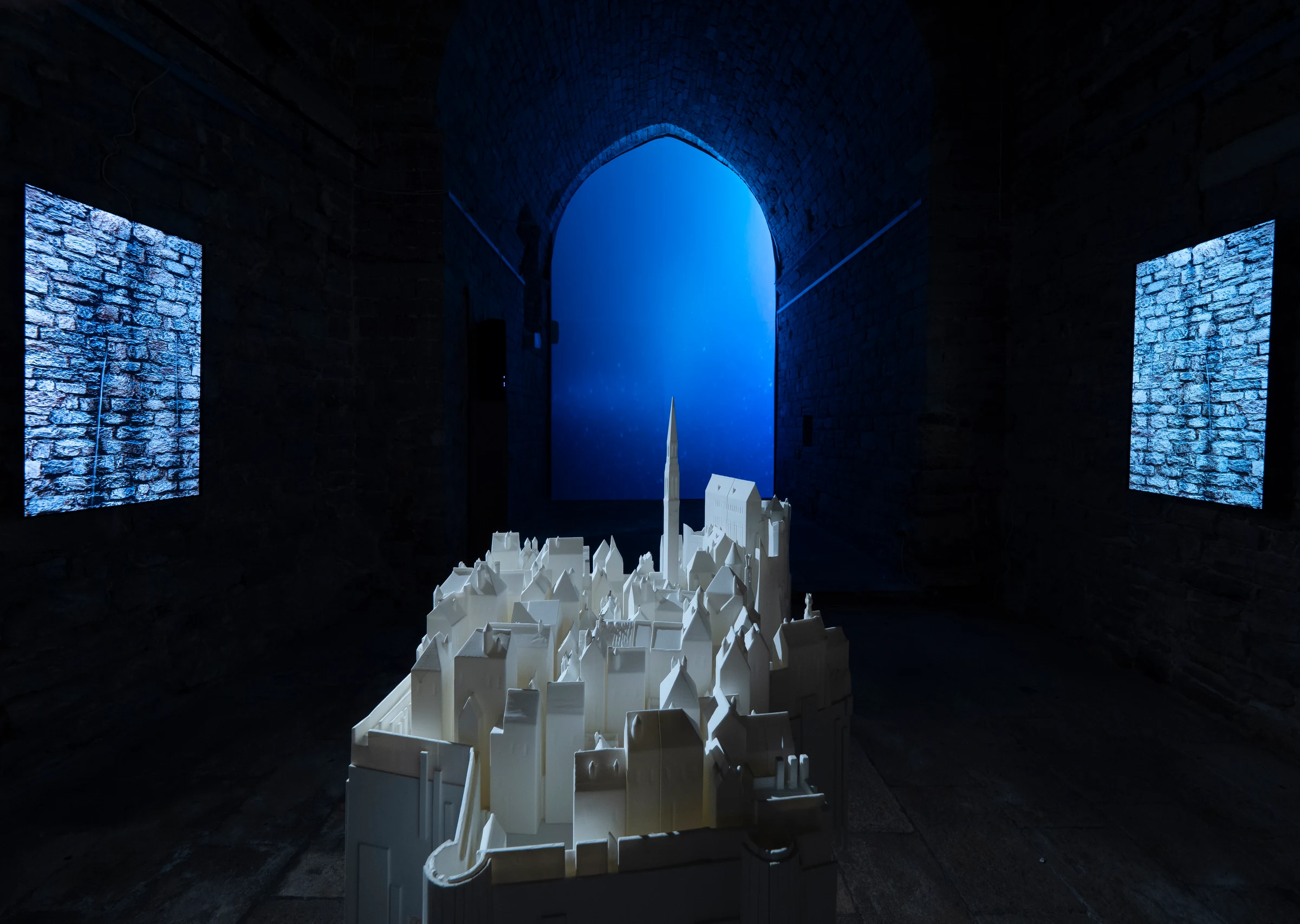
BREVIARY FOR A NEW TOWN True, there is clarity and form, geometry and logic, law and justice, knowledge and poetics, but there is everything opposed to them as well: holy books of love and reconciliation along with crusades and jihads, the ecumenical spirit and fanatical ostracism… The Mediterranean has raised monuments to faith and superstition, magnanimity and vanity.1 Predrag Matvejević In Siniša Radulović's environmental multimedia installation Equilibrium (2026), presented in the former church of Santa Maria in Punta in Budva, the carefully arranged objects and moving images - a lifeless fig tree, videos featuring water, a modified model of Budva's Old Town, and hybrid book-photographs - coalesce into a harmonious constellation within a place where miracles may seem possible. With Equilibrium, the building itself, the church-gallery, is being re-sacralized, though not through a return to its original liturgical function, nor through the introduction of a mythical atmosphere, ritual charge, or religious exaltation, but rather through a particular form of epiphany: an artistic one. The former “vocation” of the space, which today houses art, the vocation of a sacred site, is gently softened by the symbolic and affective agency of art and by its transformative potential. At the same time, the building's original function and the physiognomy of the space continue to bestow a special aura upon the art it shelters. This work engages that gift both wholeheartedly and meticulously. The equilibrium established within this installation is not the product of a supernatural, mystical force, but of the refined creative attunement of its material components, its "organs and bodies", with the anatomy and memory of the place that receives and arranges them, and with the viewer's devoted presence, which oscillates between free surrender to enchantment and a self-aware, inquisitive immersion into the densely woven fabric of its signs, symbols and archetypes. 1 Predrag Matvejević, Mediterranean – Cultural Landscape, University of California Press, Berkeley and Los Angeles, 1999, 12-13 WATER In the "holiest" part of the church-gallery, upon the wall of the apsidal niche, a video projection shows the blue expanse of water rising and falling in a steady, gentle, almost mantric rhythm. Water is a natural force with many faces, endowed with the powers of movement, speed, ferocity, impact, overflow and descent, but also of stillness, adaptation, and disappearance, suspended between destruction and purification, excess and delicacy. All these qualities are present here in latent form, synthesized into an extraordinary balance between the states and sensations of its abstraction, virtuality, immeasurable extension and actualization through the natural, harmonious rhythm of ascent and descent, emergence and withdrawal, oscillation between depth and surface. As Friedrich Nietzsche might say, one comes to know about water that it "at times it lies spread out like silk and ·gold and reveries of graciousness. But hours will come when you will realize that it is infinite"2. This video seems to "pierce" the wall, dissolving an ontological boundary. It opens itself, and opens us, to the intuition of something existing beyond and behind the image: a boundless realm, an otherworldly expanse, the "Great Water" as materia prima, as a cardinal archetype. Yet the rising and falling of the water level signifies living matter following its natural cycle of ebb and flow. We attune ourselves to that rhythm through the metric of inhalation and exhalation. The upward swell of the water straightens and elevates the body through a deep breath; its retreat resonates with our exhalation. The vital sensation of surfacing and submerging becomes entwined with the calming deepening of our breathing. In many of Bill Viola's video works, the encounter between human beings and water as a transformative and purifying force is rendered both monumental and charged with tension, imbued with cathartic power. Water functions as a threshold between two worlds, granting passage in both directions: between life and death, the visible and the invisible, the material and the spiritual. Immersion in water and emergence from it constitute a rite of passage, an act of purification, a form of deliverance. There are no human figures in Siniša Radulović's video, yet this immeasurable being of water, "framed" within the apsidal projection, absorbs the receptive viewer. Through this central projection, the exhibition space becomes a kind of magical observatory or underwater capsule through which the viewer opens themselves to self- observation: to finding their centre within the "weight" of their own body, within the refinement of their senses and within the ease of "submerging" or "emerging", of "ascending" 2 Friedrich Nietzsche, The Gay Science: With a Prelude in Rhymes and an Appendix of Songs, Vintage Books, New York, 1974, 180 towards an expanse that reaches into the realm of the imaginary and the archetypal, into the domain of the immaterial. Human participation in these delicate relations appears as an act of initiation, of "conversion", of becoming at home within an artistically organised space endowed with emancipatory force. On two screens positioned to either side of the central apsidal projection, identical video images unfold like the lateral wings of an altarpiece. Here we witness the "miracle" of water springing from the wall of the church-gallery, from barren rock itself. This miracle is known to mythologies, religions, legends and vernacular beliefs alike. Water is invested with attributes of sanctity and miracle-working power, able to transform what is firm and hardened, what is resistant and immobile, into something pliant, traversable, permeable, gentle and pure. Yet this miracle does not occur of its own accord. It is linked to the active presence of a human being, to a decisive intervention or to a state of calm and consistent concentration (the striking of a rock with a staff, or the prayer of a sage, initiate, saint or messiah). And for it to be recognised as a miracle at all, there must be a human witness, someone who acknowledges and believes. Here, that miracle is mediated by a secular image which, within the constellation of the work's elements, may prompt the viewer to believe that, in witnessing the miracle, it has occurred for them and because of them; that they themselves are the source or point of convergence of this extraordinary event and that they, ultimately, might partake of the very nature of water. But what kind of miracle is this? The Great Water, the force that relinquished its measurable dimensions to evoke a sense of infinity, to the beyond towards which the central video opens, has in the side projections turned back upon itself, spread laterally, become embodied, become living water that courses even through stone, manifesting either a "miracle of nature" or, rather, the true nature of water itself: its capacity to carve a path with quiet persistence and calm, unwavering strength. TREE The central axis around which all the elements of the installation orbit is established by a lifeless fig tree, raised upright at
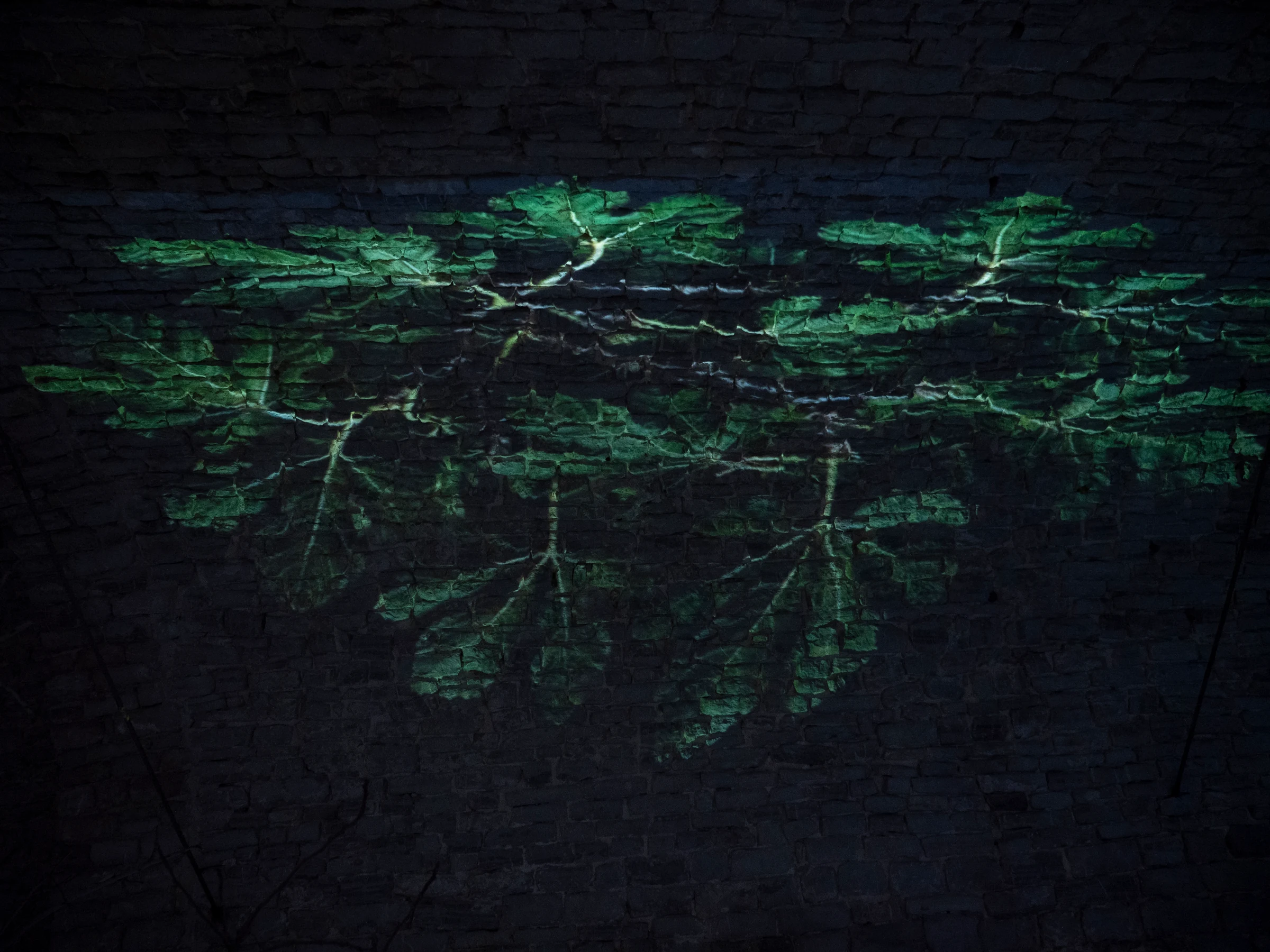
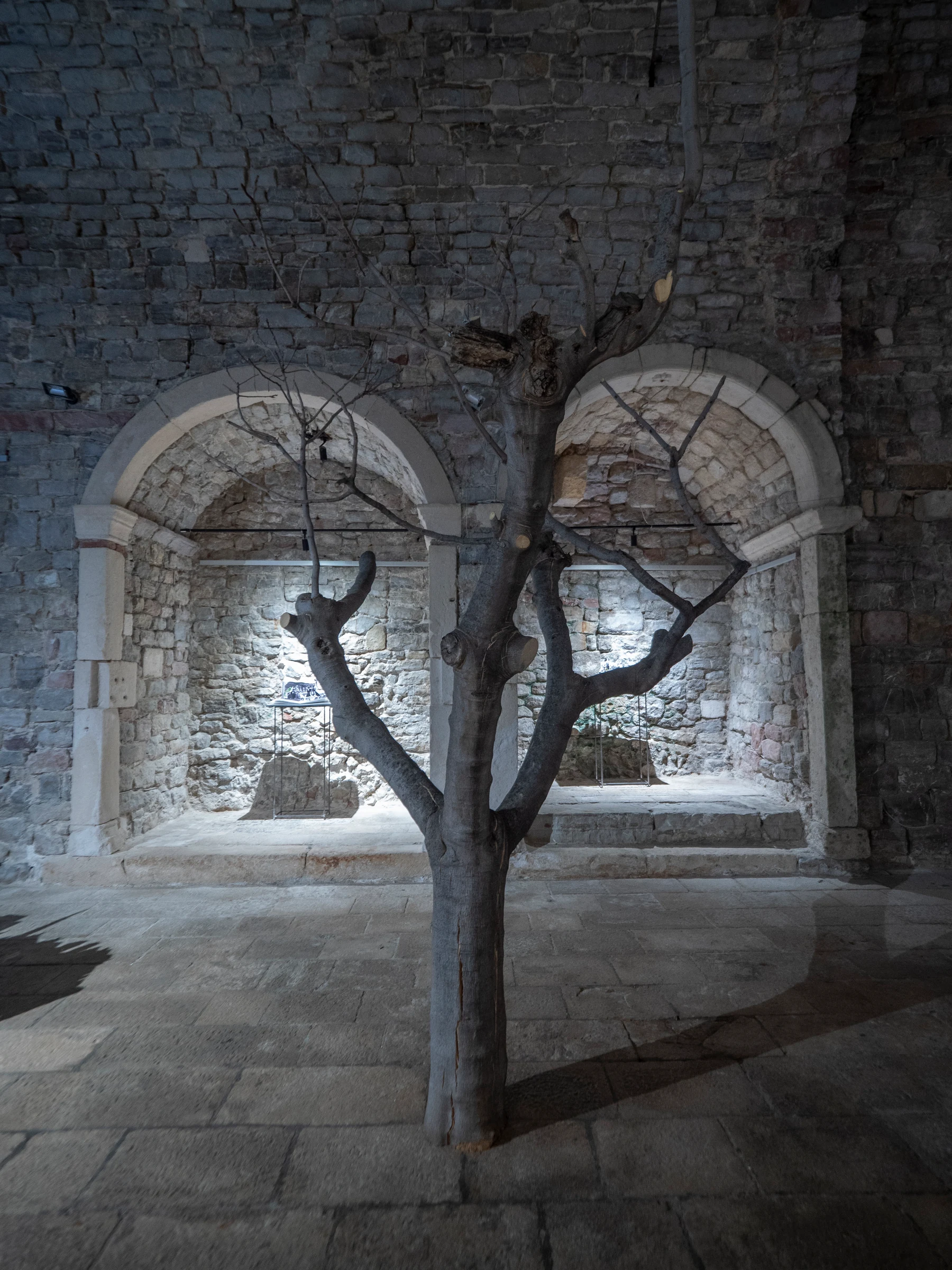
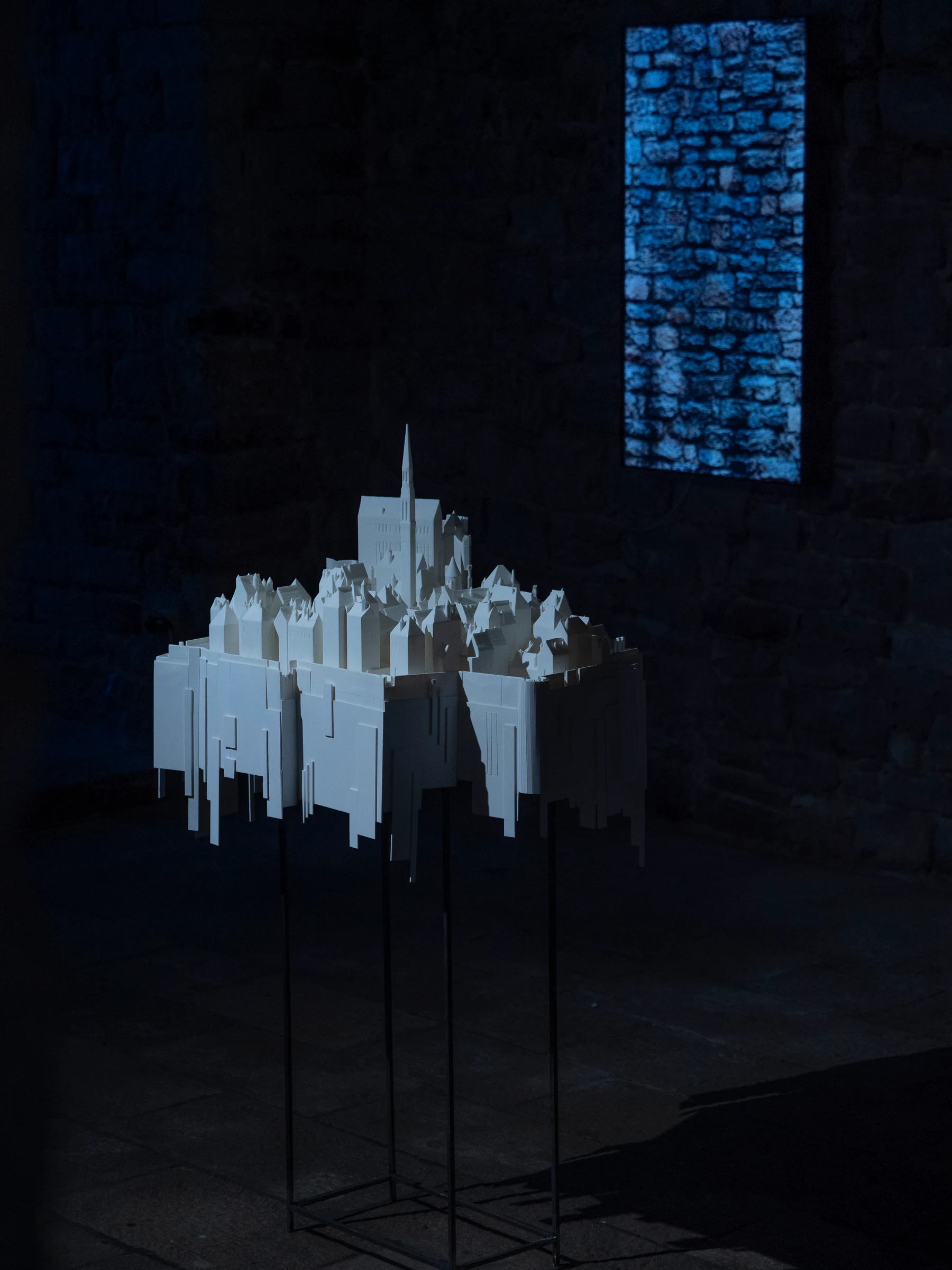
the centre of the church-gallery. In Terence Koh's multimedia exhibition Bee Chapel (2016), a fallen apple tree, seemingly dead yet not entirely devoid of life, forms the centre of the work. Laid on the ground, its roots were watered daily in an attempt to revive it. EEG cables attached to its roots were intended to detect signs of life. The artist named the tree Eve, and the work can be read as an act of forgiveness and redemption for the one expelled from Paradise, a return to life. In the series Alberi (Trees), which Giuseppe Penone began in 1969, the artist removed the outer layers of a tree trunk, peeling away the strata of time. In doing so, he revealed and liberated the sapling from which the tree originally grew, exposing its youthful "heart", an inner core untouched by the passage of time. In Ai Weiwei's series Trees (2009–2010), monumental sculptural forms represent branching trees assembled from fragments of different fallen trees collected throughout China. The stumps are joined together with metal bolts to eventually "branch out" into a new, composite tree. Yet the tree remains fundamentally deprived of vitality, fragmented and marked by cuts, seams and scars. This is an engaged and critical reflection on the artificiality of attempts to integrate a unified, homogeneous body by "stitching together" its parts – the body of a state, a nation or an institution – under the illusion of unity and coherence. It is also an intimate work, an ode to trees which, as the artist's father writes in his poem Trees, stand separated and individuated above ground while their roots remain intertwined below. It is a powerful image of the natural need for connection, for attunement. It is an ode to nature, but also to harmonious human communities. In Anselm Kiefer's monumental installation Palm Sunday (2006), a large dead palm tree lies across the gallery floor. Palm fronds welcomed Christ's entry into Jerusalem, marking the beginning of his Via Dolorosa, the path of suffering without which his resurrection could not occur and without which the promise of human salvation and redemption could not be fulfilled. The palm is also an ancient symbol of military triumph and victory over death. At the same time, the work is a powerful secular meditation on life and death, on the cyclical order of nature and on the universal notion of decline, destruction and entropy as prerequisites for renewal, for a new beginning. The tree-column, the foundational entity upon which the building–city–forest rests and from which it comes into being, is featured in the installation Equilibrium as an inanimate body, as a corpus stripped of life and function. Within religious discourse, death as finality is defied. In this work, the raising of the “fallen” body is neither an irrational attempt to reanimate the deceased nor an act of mourning for what is irretrievably lost. Nor is it a Frankensteinian project of grotesque assembly and macabre resurrection. The raised corpse has not become a totem of hope in an afterlife. The dead tree "rises", ascends and restores its vitality through the supplementary, virtual space of the image, through a video projection that "grows" out of the trunk and spreads across the vault of the church-gallery, revealing treetops and branches swaying in the wind. In the celebrated Isenheim Altarpiece (1512–1516), the polyptych by the German Renaissance artist Matthias Grünewald, the central position is occupied by a harrowing and dramatic Crucifixion scene in which Christ's body appears shockingly and brutally ravaged, displaying the symptoms of St Anthony's Fire, the disease from which sufferers were treated in the hospital of the church for which the altarpiece was created – the Monastery of St Anthony in Isenheim. Part of the healing process lay in the identification with the body of the crucified Saviour, but also in the fact that, when the wings of the altarpiece bearing the Crucifixion were opened, scenes preceding and proceeding from this event were revealed within, at the very heart of the work: the Nativity and the Resurrection of Christ. Rendered with extraordinary virtuosity as both a sumptuous painterly and cosmic event, these scenes constitute a manifesto of ultimate hope and the promise of final salvation and redemption. Instead of a spectacle of faith and hope, Equilibrium offers a secular mysticism. The tree comes to life, bursts into leaf, through a secular moving image. What unfolds here is the all- pervasive force of a compelling artistic concept, of an environmental and sensorial staging, a kind of "healing" through a profane image, through the “small magic” of leaves trembling in the wind. This installation introduces a rich and productive paradox: the electronic image, an inanimate, technologically processed and fluid body, not only reanimates a real, tangible yet withered body, but also summons the outside world into an enclosed space, activating a sensation of circulating air and freshness, a feeling of arresting a moment of living presence. This poetic moving image requires a dead body as its material support in order to manifest its "miraculous" agency, its "healing" power and the affective ability and efficacy of its agency, just as devitalised nature – the body of nature itself – today requires the spectacle of contemporary visual media to perform its own immortality. The making of miracles belongs not only to sacred images that inhabit the realm of the supernatural, but also to technological, electronic and artistic images that seem "immune to death". Virtuality requires matter, the image requires a body, solidity requires the flickering and the fluid, darkness requires light. The magical and restorative force of these profane images rests not on faith but on the affective power of the image itself, drawing equally upon the soul's ascents and the rapture of the senses. The symbolism of the tree and the fig fruit further entwine passion, pleasure, fertility, abundance and a state of inner peace and enlightenment. The metal cables that hold the lifeless tree upright like a prosthesis become an emblem of care and commitment, an invention designed to support and sustain, a pledge of perseverance. The miracle of the image, the magic of "reviving" and "branching out" a dead body, is reinforced by its "transplantation" into a place of impossible growth, into the enclosed interior of a stone chamber. The very space of the artistic act is thus activated as a dedicated site of magical transubstantiations, released from the obligations of any dogma or canon. This profane image embodies – or perhaps disembodies – a liminal condition of things, operating as an osmotic membrane that productively oscillates between permanence and ephemerality, between matter, the tangible and the solid, and that which is intangible, fluid and on the verge of disappearance. TOWN Positioned along the longitudinal axis of the church-gallery is a model of a modified Old Town of Budva – a model of a white town whose elongated structures surge upwards in an ecstatic ascent. This micro-town is not, therefore, a miniature replica, a copy of the actual town, the town that has "devoured itself", that has fallen victim to excess, that has abandoned the horizon, open space and a measured, attentive spatial unfolding. Nor is it a blueprint of a fantastical, fairy-tale, impossible town. It grows upwards not like a skyscraper but like a cathedral. In its tectonics of levitation, it exists in a weightless state, freed from the Scylla and Charybdis of the various "gravitational forces" – history, society, functionality – that seek to fix it in place, immobilise it and confine it within the matrices of their own limitations. Thus, even in its fragility,
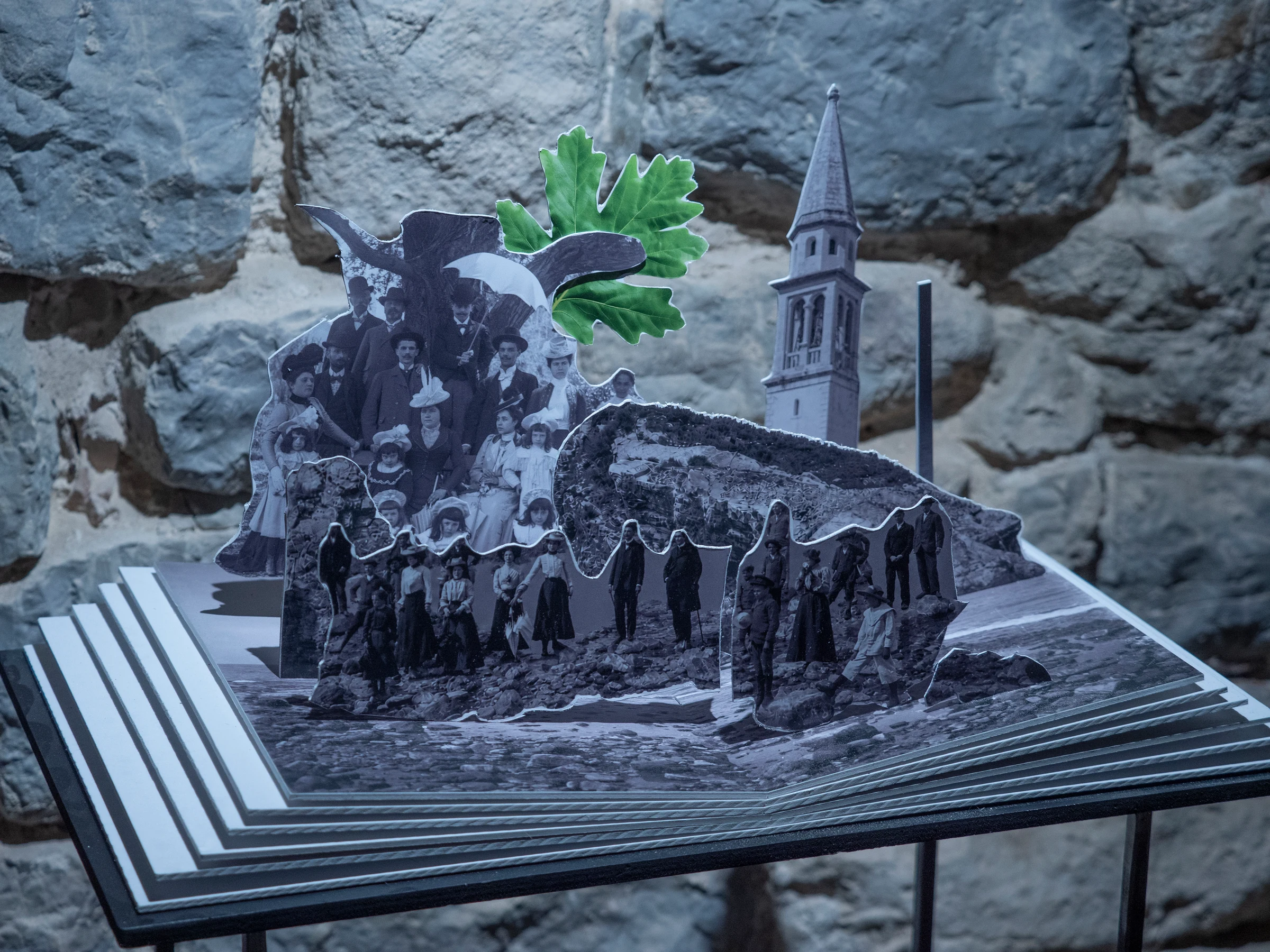
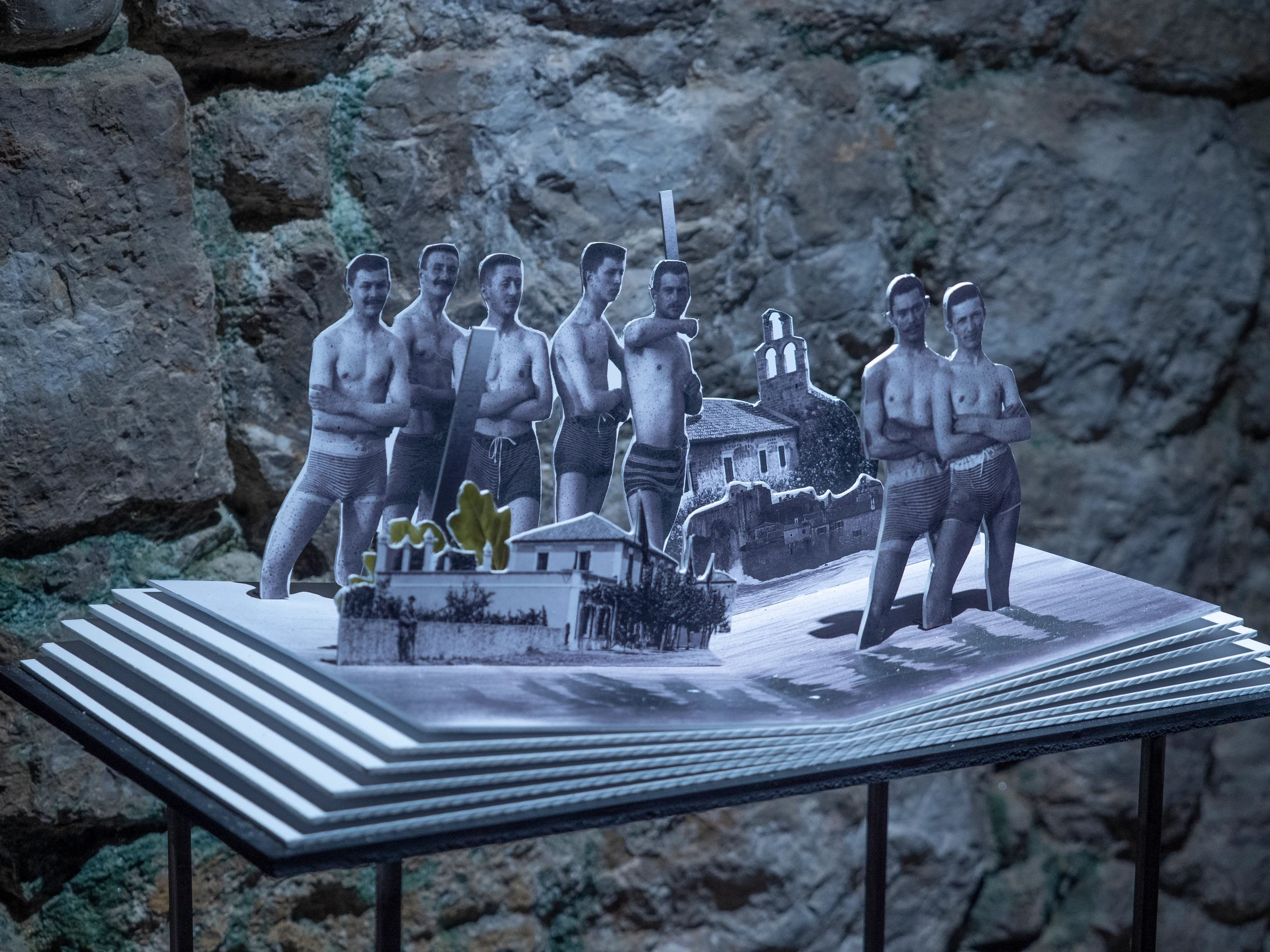
it remains protected from devastation and from leviathans. Italo Calvino might have said that it is "a dream born out of the heart of the unbearable cities we know"3. This micro-town is a seed, a nucleus, the pure heart of the real town as a human settlement, as an act of equilibrium that synchronises all the constitutive elements of a comprehensive urban habitat. It is also the echo of a meta-structure, of a harmonious architecture of the self, a "construction" of purified and elevated forms, relations and states that underpins every balanced act of building, every thoughtfully organised community. Like a refined and quiet magical apparition at the centre of the installation, this town is "lapped" by water, both as a fluid and boundless force and as the "miraculous" living water that springs from stone. From it, the mystically foliated lifeless fig tree may also "grow". The composite book-images placed within the niches of the church-gallery – a breviary for a new town and new people – affirm its tangibility, its reality and its gravitational pull towards human beings: those who came before us and those who inhabit the present alike. 3 Italo Calvino, “Italo Calvino on Invisible Cities“, Columbia: A Journal of Literature and Art, No. 8, Spring/ Summer, 1983, 40 PEOPLE In the oeuvre of Budva photographer Marko Anzulović from the early twentieth century, one finds views of the fortified Old Town in harmonious coexistence with its surroundings, nestled between the green belt of meadows and vegetation and the blue expanse of the sea. One also finds images of a gentle "forest" of people and situations planted throughout the town: in its squares, marketplaces and waterfront, its harbour, island beaches, village courtyards and the intimate realms of home and private life. As Predrag Matvejević writes, they become "from time to time open-air stages. Upon them are enacted different roles, insignificant and fateful alike; rituals are performed, both everyday and eternal"4. They define a vanished analogue era and the relationships of immediacy and intimacy that belonged to it. Untouched by the seductions of the camera and uncommodified by photography, these figures pose without self-consciousness. Unpretentious both in their daily duties and in popular celebrations, they remain blissfully unaware that the photographic record, captured with subtlety and devotion, will preserve them as a tender trace of chance in time. In Equilibrium, figures, buildings and settings are cut from different photographs, rearranged into a new synthetic spatial-temporal structure and gathered into clusters in which the places and moments from which they originate contract and intersect without forfeiting their authenticity. The effect is not one of uncanny collage infused with Surrealist charge, but of grafting through which a new, organic quality of existence is extracted. What is animated is a symbiotic duration: the persistence of stone as Fernand Braudel’s longue durée of the town, the expanse of water and the town's embrace by the sea, together with the everyday life of its inhabitants who, within this photographic assemblage, outgrow in scale the town, its surroundings and the coastline itself. Yet they do not thereby become mythical giants, guardians invested with a special mission, nor are these sedimented images mere testaments to a vanished age, archives of scenes, events and settings locked away in lost time, for photography here does not function as a mechanism of remembrance. Rather, they become cheerful and active symbolic and psychological points of orientation for people today, for all that is lost, sought and rediscovered in the human condition; for ways of being that are at once purposeful and pleasurable; for the grandeur of belonging and the mutual, attentive possession of people and the town through which both the town and its inhabitants are elevated and allowed to grow. This is not a story of transience but of life's capacity for renewal. And this storytelling through image grows from an open book. 4 Predrag Matvejević, Mediterranean – Cultural Landscape, University of California Press, Berkeley and Los Angeles, 1999, 65 BOOK-IMAGE Open books are suspended within the niches of the church-gallery, from which these spatially arranged photographic fragments, these photo-collages, emerge. An open book is a state of receptivity in which its body offers itself up, inviting appropriation and encounter. Within (or perhaps beyond) the Barthesian intersection of book and photographic image, the weaving together of two systems of signs, Equilibrium sees the book relinquish writing and text in favour of the textuality, narrativity and eventfulness of photographic images. The flatness and linearity of the book's pages and of the image’s surface give way to layered, sedimented planes composed of fragments from different photographs that "grow" upwards from the book in an upright formation. Together they create a kind of unconventional polyptych, an altarpiece that depicts the everyday lives of ordinary people. Through this sediment of images, the book itself is elevated physically, symbolically and semantically. Its structure becomes more complex, more richly articulated. This book does not preserve its palimpsestic character through metaphor alone, through semantic depth and layering of meaning. Instead, it materialises those layers, translating them into images arranged in multiple spatial planes. No hierarchy exists among these visual strata, no distinction between foreground and backdrop. They endow the book with qualities of authentic visuality and objecthood, with relief, multiperspectivism and a distinctive sense of scenographic and theatrical. The saga of the town thus undergoes a kind of transubstantiation into an image – into a fragmented, stratified, composite book-image. In the interplay between the model, the reduced version of a town elevated towards a more noble mode of existence, and the symbiotic union of book and photograph, within which the real people depicted in the collaged images outgrow the dimensions of the actual town they once inhabited in a time of noble simplicity, reduction and enlargement are not concerned with physical scale, competitive relations or utopian projections of an ideal future town. Nor are they concerned with retrotopian, nostalgic reconstructions of the past through its images. The aim of this construct is neither to dissect nor to evoke the past, but rather to filter experiences, moments and sensations from that earlier time as an active present. Placed within the niches of a former church, these book-images resemble small artistic reliquaries. Yet rather than housing the body of a saint as an object of faith, they preserve the body of memory as a support for active life. What is at stake, then, is not the mere sedimentation of memory but the planting of a vital forest of visual, semantic and affective signs that recode memory into living perceptual experience, into an alternative narrative that may be read as the intimate story of every inhabitant of the town. This book-image is not a "holy book", yet it is a "sacred territory" – a floating island for the authentic consecration of speech, thought, feeling and experience, an island of meaning. This open book without text is a protected place where the town and its people may nest as on an island of salvation: an Equi-liber (book-balance) for
Equilibrium – the balance of all things. HETEROTOPIA AND "PROFANE ILLUMINATION" The former church, stripped of its inherent function, does not, through this congregation of artistic elements, rehabilitate the building's original sacredness in an institutional or ritual sense. Rather, it gently transforms the history and memory of the site into an environmental and affective constellation, into a hypersensitised artistic space. We experience it as an artistic refuge, an oasis, an island of salvation, a kind of Noah's Ark whose purpose is to preserve endangered species: the tree, the town, the book and the people. Walter Benjamin introduces the concept of "profane illumination", a secular epiphany that departs from the mystical and messianic spirit and affirms materialist, worldly inspiration. It is associated with the small "miracles" of everyday life, with the aura of ordinary things, with the "magic" of inconspicuous lived experiences. “For histrionic or fanatical stress on the mysterious side of the mysterious takes us no further; we penetrate the mystery only to the degree that we recognize it in the everyday world, by virtue of a dialectical optic that perceives the everyday as impenetrable, the impenetrable as everyday."5 For Benjamin, this is an awakening from the hypnotic spell of the capitalist, consumerist matrix, one capable of revolutionising reality and transforming society. In the case of Equilibrium, "profane illumination" concerns an authentically artistic, worldly revelation: the creation of a consecrated place, a space of singularity, the establishment of a refined and enduring network of archetypal centres. Water, tree, book, town and image are those centres, elegantly, profoundly and sensitively permeating the space. They constitute the foundations of this spatial-semantic architecture, of this sustainable eco-artistic system within which the "miracles" of regeneration become possible. 5 Walter Benjamin, “Surrealism: the Last Snapshot of the European Intelligentsia”, New Left Review. Vol. 108, March-April 1978, 55 By entering the space of Siniša Radulović's Equilibrium, we enter a kind of Foucauldian heterotopia, “a space that is other, another real space, as perfect, as meticulous, as well arranged as ours is messy, ill constructed, and jumbled. This latter type would be the heterotopia, not of illusion, but of compensation".6 The deliberate disproportioning of the work's elements is not intended to destabilise the viewer. Rather, the conceptual calibration of their scale, relationships and meanings induces a kind of gyroscopic centring. The viewer themselves becomes a node, a focal point at which the spatial, symbolic and semantic trajectories of all the constitutive elements of the work intersect and come into balance. They are ushered into a state of inner equilibrium and brought into alignment with their own axis. In doing so, the viewer either locks or unlocks the delicate yet precise mechanism of the work, a mechanism whose operation derives from the encounter between the sacred and the profane, the solid and the fluid, the immense and minute, the body and the image, and upon the fraternity of these "sacred" things: water, tree, book, town and human being. Svetlana Racanović Translated by Jelena Ray Stanovnik